
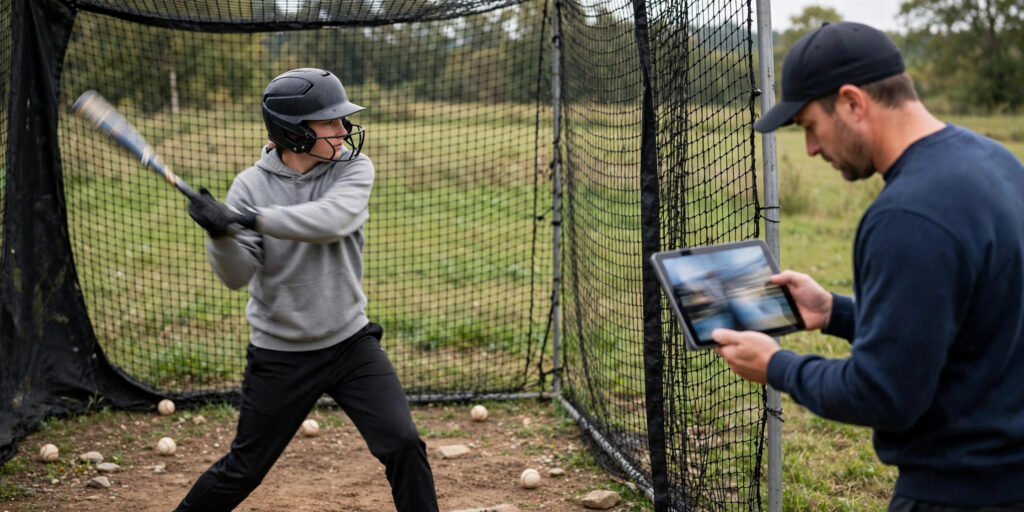
At 2-0, you are prepared for a fastball through the middle. You reach for a cutter well off the outer edge and drop a single behind first base. Later, the same pitcher gets you to reach again and records an easy out. In your review, what earns attention from that first hit?
Begin with your own account. Suppose you say you recognized the pitch outside your selected area and swung because you wanted a hit immediately. That gives the review something specific to examine. Another hitter may have read the pitch differently or made an intentional adjustment supported by the situation. The single supplies the result; the evaluation needs the preparation and choice that produced it.
Rebuild the game before choosing the lesson
After a game or practice, select a few decisions that represent what you were working on. Record the count, pitch and location as accurately as available evidence allows. Add what you expected and what you recognized before committing. Include uncertainty where your memory or the view is limited. Reconstruct enough of the sequence to see how you reached that pitch.
For the 2-0 single, ask what made the middle fastball a useful starting plan. Had the pitcher been throwing it for strikes? Could he land the cutter in the zone? Was there a team assignment? Your selected area should have a competitive reason. Following a plan offers little developmental value if the plan itself ignored the opponent or your strengths.
Then examine the swing decision and its execution. In the supplied account, you recognized that the cutter missed your area and decided to reach because you wanted the result. That is a selection issue worth teaching. How you moved the barrel is a related execution question. A ball falling safely does not establish that either part should be repeated.
Consider what the pitcher learned
The pitcher and catcher also receive information from your swing. If they see you reach for a pitch off the plate, they may test that area again. Across later plate appearances, watch whether cutters continue to finish there, whether they enter for strikes and what follows when you take. Repeated execution and your responses give the interpretation more support. A single cutter cannot establish their attack plan.
Your next opportunity at 2-0 still requires an updated decision. With permission to hit, you can remain ready for a pitch in your useful area while recognizing the cutter’s path. If the pitcher begins landing it on the outer edge for strikes and keeps the fastball away from your preferred area, review whether your initial selection remains realistic. At two strikes, your coverage must account for strike locations beyond a narrow early attack area.
Make reinforcement specific
Reinforcement concerns what a response encourages you to repeat. Praise, attention and your own explanation of success can all influence that learning. When you tell yourself, “I got a hit because I went after it,” the account may encourage another reach. A more accurate review can acknowledge the single and identify that you left a workable selection plan after recognizing a ball outside it.
Apply the same standard to an out. If you recognized a pitch that fit the count, assignment and your coverage, then executed the intended swing, a defender catching it leaves useful work to retain. Review contact execution where needed. Keep the evaluation consistent enough that you know which behavior is being developed across both outcomes.
Practice the identified selection boundary in a controlled practice exercise with swings limited to the chosen attack area. Continue the count after each pitch and discuss a few representative choices. The restriction comes off in game-like training, where the actual count, pitch and assignment guide the decision. Include a pitcher who can change locations after you demonstrate a take.
Finish your review with one development target and a reason for it. Revisit the target over later opportunities and check whether the trained behavior appears.
The same question matters on the softball field: what a hit is teaching her to repeat. What are we encouraging her to repeat after a hit?
If this is the work your hitter needs, my $199 Strategic Hitter evaluation is where it starts. Explore the $199 Strategic Hitting Evaluation
Explore the HittersIQ System to understand how we develop the strategic side of hitting.